
DMN4DQ: When data quality meets DMN
Abstract
To succeed in their business processes, organizations need data that not only attains suitable levels of quality for the task at hand, but that can also be considered as usable for the business. However, many researchers ground the potential usability of the data on its quality. Organizations would benefit from receiving recommendations on the usability of the data before its use. We propose that the recommendation on the usability of the data be supported by a decision process, which includes a context-dependent data-quality assessment based on business rules. Ideally, this recommendation would be generated automatically. Decision Model and Notation (DMN) enables the assessment of data quality based on the evaluation of business rules, and also, provides stakeholders (e.g., data stewards) with sound support for the automation of the whole process of generation of a recommendation regarding usability based on data quality.\n The main contribution of the proposal involves designing and enabling both DMN-driven mechanisms and a guiding methodology (DMN4DQ) to support the automatic generation of a decision-based recommendation on the potential usability of a data record in terms of its level of data quality. Furthermore, the validation of the proposal is performed through the application of a real dataset.
DMN4DQ in a Nutshell
DMN4DQ is a methodology that enables the automatic generation of recommendations on the potential usability of data in terms of its level of data quality. DMN4DQ relies on establishing a hierarchy of business rules for data quality which enables the validation of data attributes, the measurement of data quality dimensions, and the
assessment of the level of data quality. This hierarchy of business rules is supported by the decision model and notation paradigm (DMN). DMN is the modeling language and standard notation defined by OMG to describe decision rules. These rules take the form of the “if-then” structure of traditional programming languages. From the definition of a data model that is supported by a set of engines, for example, Camunda–DMN Engine, we see in this combination a possibility for the development of the study and the assessment of data quality.
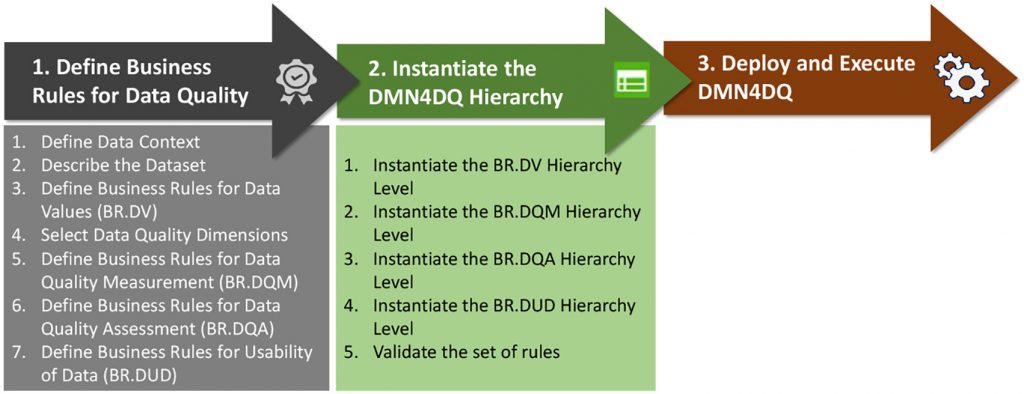
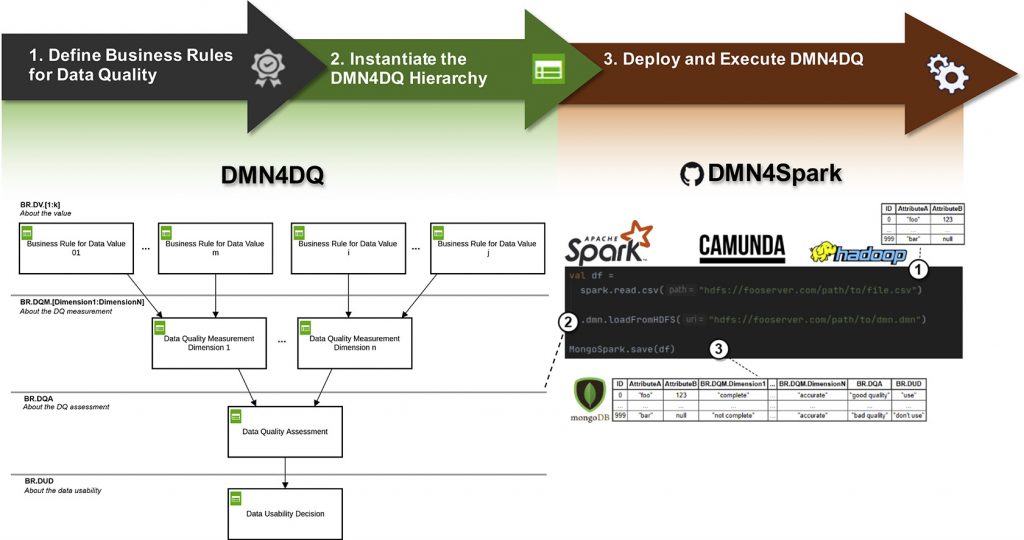
In the hierarchy of the decision model (DMN), we present four levels in the hierarchy of business rules, distributed as follows:
- Instantiate the business rules for data values (BR.DV) hierarchy level.
- Instantiate the business rules for data quality measurement (BR.DQM) hierarchy level.
- Instantiate the business rules for data quality assessment (BR.DQA) hierarchy level.
- Instantiate the business rules for data usability decision (BR.DUD) hierarchy level.
DMN4Spark is provided as a tool suite to enable the execution of the methodology of DMN4DQ in any scenario.
Results
Álvaro Valencia-Parra, Luisa Parody, Ángel Jesús Varela-Vaca, Ismael Caballero, María Teresa Gómez-López,DMN4DQ: When data quality meets DMN, Decision Support Systems,
Volume 141, 2021, 113450, ISSN 0167-9236,https://doi.org/10.1016/j.dss.2020.113450.